The eloquence of professional storytellers in Hagerstown helps us to not forget our past
By Lisa Gregory / Photography by Rick Gregory
It began with a quilt. A little girl sitting on one on her bed hearing a story from her father about a little slave boy who was given one. The little girl was Fanny Crawford. The little boy was her great-great-grandfather, Henry.
“When he was sold his mother gave him a quilt so he could remember his family and where he came from,” says Crawford of Hagerstown. “My father bought a quilt for me at the flea market. He would say that this quilt was very much like the ones that belonged to my grandmother and great-grandmother. And because the quilts were made from old clothing they reminded them of the people who had come before.
Much like the stories her father told her of his grandfather and her great-grandfather, T.H. Barnes.
“He wanted me to know my family history,” she says. Much of that history came from a manuscript written by T.H. before his death. And while she loved books and having books read to her, there was something special about the stories her father told her. “Knowing that this was my family,” she says. “A family that I had never met. I was fascinated.”
Now she is telling those same stories as a professional storyteller. And people are listening.
Following the isolation of Covid and the current deluge of technology resulting in digital fatigue, in-person experiences can have more of an allure. That includes storytelling with people gathering for such events as open mic story slam competitions and storytelling festivals.
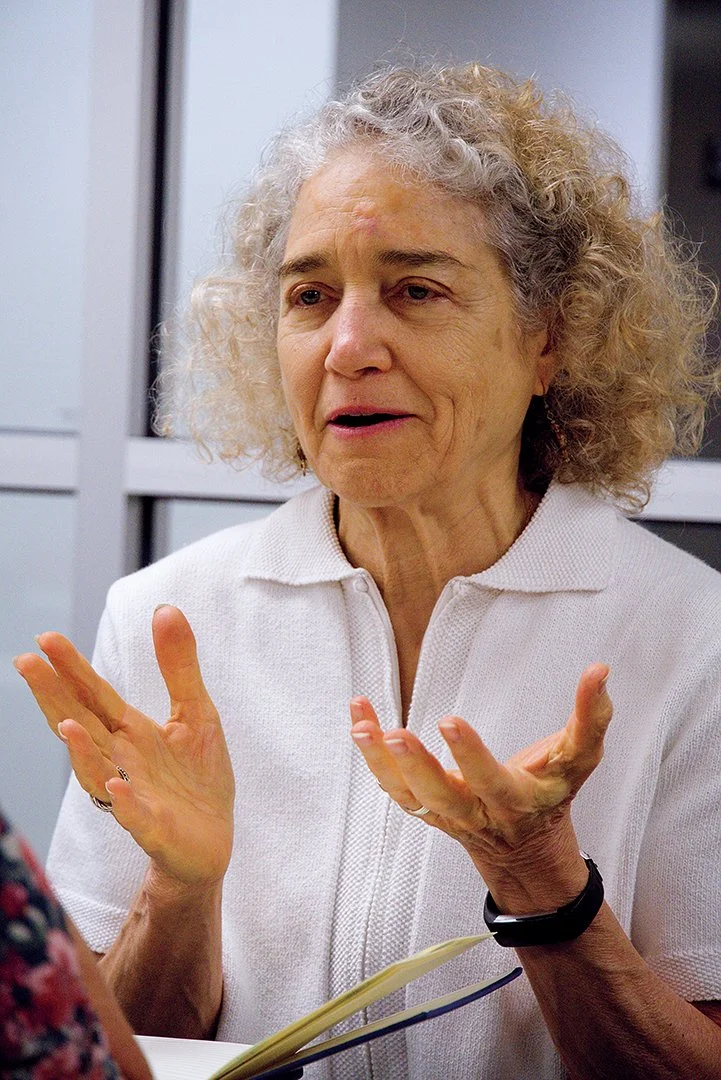
Professional storyteller Fannie Crawford.
“I think it’s a basic tendency to desire human interaction over isolation,” says Susan O’Connor, who was director of programs for 35 years with the International Storytelling Center in Jonesborough, Tennessee. “And it’s a need made more important than ever in this digital era. There is scientific research that shows how group responses, like laughter or other emotions, can change and enhance one’s personal experience of a performance—be it storytelling, a concert or even a film.”
As a storyteller, Crawford is doing her part locally. She is the founder of Stories in the Round, a monthly storytelling series held at the Unitarian Universalist Church in Hagerstown. She is also the co-host of the podcast, “The Storytelling Hour”, with fellow storyteller Stas Ziolowski. And she shares her stories at historical association meetings, house concerts, festivals, libraries, day care centers and summer camps.
Much like her father’s stories, Crawford, a retired nonprofit director who worked in children’s health and education, tells stories from the manuscript written by T.H. Barnes, including the one of her great-great-grandfather, the little slave boy and his quilt.
It is one especially close to her heart. “He wasn’t just a little boy in a story,” she says. “He was my little boy.”
According to T.H.’s manuscript, Henry, who was born in about the year 1818 in Virginia, was purchased by a Rev. Barnes, who lived in Hagerstown. Barnes purchased young Black males, requiring each one to learn a trade. He then would hire them out and claim the profits. Henry was just a small boy when Barnes purchased him. “My grandfather talked about how he struggled to adjust and how he missed his family,” says Crawford.
Although it was illegal at the time, Barnes also made certain that the slaves he purchased could read and write and use some math. “Their education would enable them to keep time and record of work performed and report the same to him (Barnes) at the conclusion of the contract,” writes T.H.
“That’s how Rev. Barnes made his wealth,” says Crawford. “And he was a very wealthy man.”
Henry became a gardener, while under the ownership of Rev. Barnes. “What we would call a horticulturist today,” says Crawford. “But back then, he was called a seed man.”
His education enabled him to expand his learning about gardening and plants. “And he knew his stuff,” says Crawford with a smile.
On his deathbed, T.H. writes that Rev. Barnes gathered his slaves around him. “He told them they had served him well, and he wanted them to go north,” says Crawford. “He wanted them to be free. To run away.”
Adding, “He gave them their manumission papers and also asked them to take his name.”
Travelling on foot, Henry left and eventually made his way to Lewiston, Pennsylvania, and freedom.
“My father said that there were no photographs of Henry,” says Crawford, “because he would never allow his picture to be taken. He always had a fear that he could be taken back to Virginia. He died before the Civil War.”
In the manuscript T.H. not only talks about Henry but about his own life as well. For example, he grew up in the Colored Orphan Asylum in New York City after Henry and his wife both passed away.
As a storyteller Crawford takes on the persona of T.H. to tell his stories using what she imagines is his voice and mannerisms though she never knew him. “I studied the older members in my family,” she says.
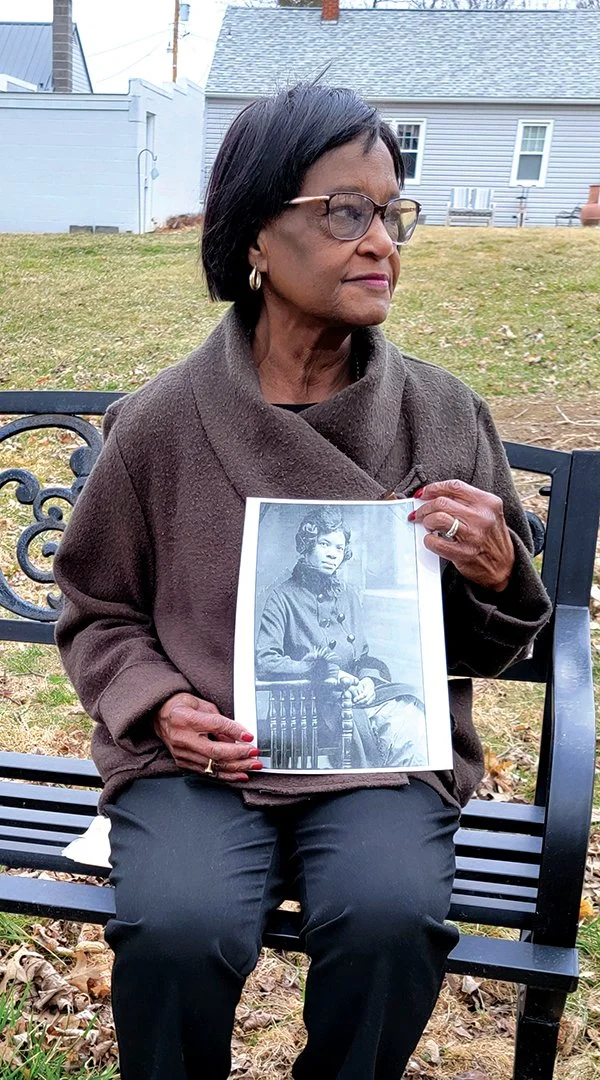
Lola Mosby.
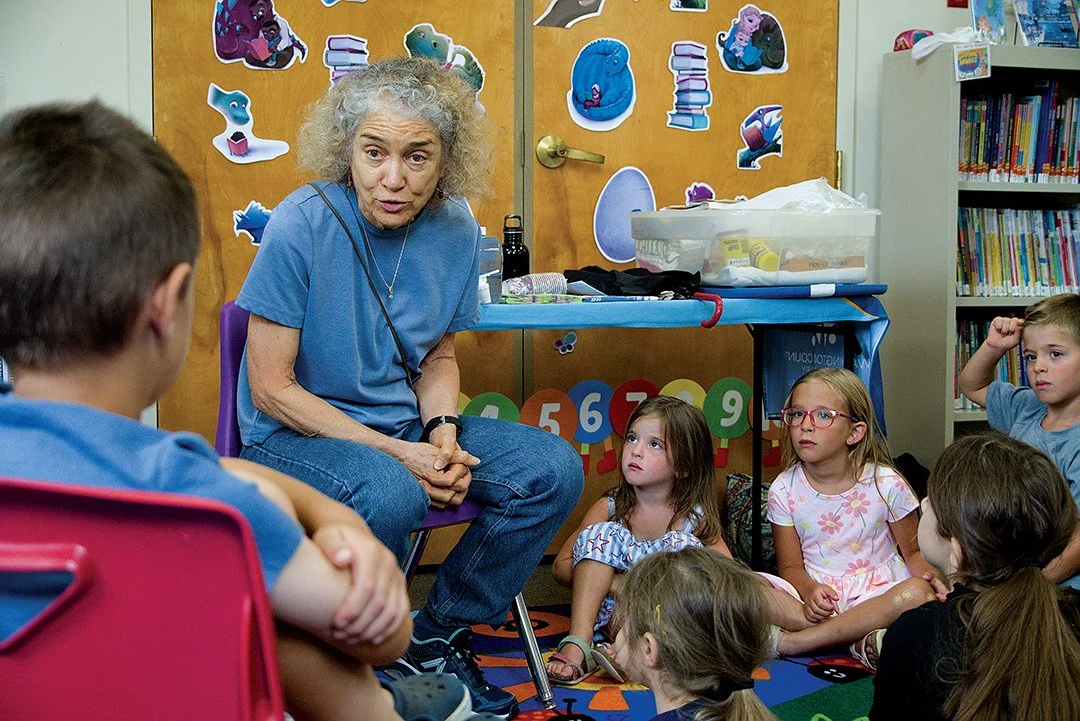
But her stories are not only inspired by the manuscript written by T.H. but include her own firsthand experiences growing up. At a recent storytelling event at Sharpsburg Library, she delighted children with the story of her brother and the “frog in his throat.”
The library is a fitting place for Crawford to perform. “My mother was a librarian,” she says. “And my father had a bookstore.” The bookstore would eventually close, however. “It wasn’t monetarily successful,” says Crawford. “He never charged enough money. But he didn’t’ care. He just wanted books out in the community.”
At one point, Crawford says she owned 4,000 books. “Most of them were from my parents,” she says.
Crawford also describes her mother as an activist and her father as a community organizer.
“My father was a street corner orator,” says Crawford, who grew up in Philadelphia. Even though, she adds, “he had a noticeable stutter.” However, “If there was an issue going on in the community and somebody asked him to speak, he would jump up and do it,” she says. “Even if he just was walking by and somebody saw him that knew him and said, ‘We’re going over to city hall. Come with us.’”
Crawford would not only inherit her love of storytelling from her father but his stutter as well. “I stuttered when I was a little girl,” she says. “I have collected stories about stuttering to show people, yes, you can do this, too.”
Her own storytelling efforts began at home, telling stories to her mother, “to make her laugh,” she says. And it was at a family reunion during the 1970s where she tested her role as a storyteller before a broader audience. “The family reunion seemed like the place to start,” she says. “If I was going to tell the family stories that should be the first place I told them.”
She shared the story of Henry and the quilt.
From there she honed her craft, attending storytelling groups. It was at one of those gatherings that she first came upon the idea of starting Stories in the Round. “Someone said, ‘We should each start a storytelling venue,’” recalls Crawford. “Some people said, ‘No, there’s no way I can do that.’ But for me, it was like, ‘I could do that.’”
More than a decade later, the stories continue at Stories in the Round with local and not-so-local storytellers performing, including Crawford. “It’s community building,” she says.
Recent storytellers have included those from the Griots’ Circle of Maryland. Located in Baltimore, the Griots’ Circle preserves and promotes African American storytelling, folklore and history through the oral tradition.
However, Crawford isn’t the only one in Hagerstown telling stories. Lola Mosby understands the power of stories and sharing family history. Mosby, now in her 80s, helped create Black Storytellers of Western Maryland. “Our stories matter,” she says.
Mosby, a twin with 18 brothers and sisters who would go on to become a successful businesswoman, tells stories about her search to learn about her great-grandfather, Jack French. She also talks about her grandmother Jacqueline French Lewis, who was only 28 when she died in childbirth. “The child died as well only a day or two later,” she says.
On a lighter note, she recalls visits to nearby John Brown’s Farm, a music mega for young African Americans and so named because of its location on the farm where abolitionist John Brown planned his 1859 raid on Harpers Ferry. During the ‘50s and ‘60s crowds gathered for such iconic acts as James Brown, Ray Charles, Aretha Franklin, Tina Turner, The Isley Brothers, The Drifters and The Coasters. “I saw Little Richard,” says Mosby.
It was a haven for young African Americans during a time of segregation.
“You need to tell these stories, so the children know them,” says Mosby. “And they will know them because you told them. So, tell them. Tell your stories.”
Mosby is right. Stories matter and always have. “Stories are as old as humanity,” says O’Connor.
In fact, cave paintings going back 30,000 to 36,000 years are some of the oldest examples of visual storytelling. Not surprising then that humans are hard-wired for stories. According to scientists, when individuals see or hear a story, the neurons in the brain fire in the same patterns as the speaker’s. The process, known as neural coupling, results in the release of powerful neurochemicals like oxytocin, dopamine and cortisol, which motivates empathy, attention and deep emotional connection.
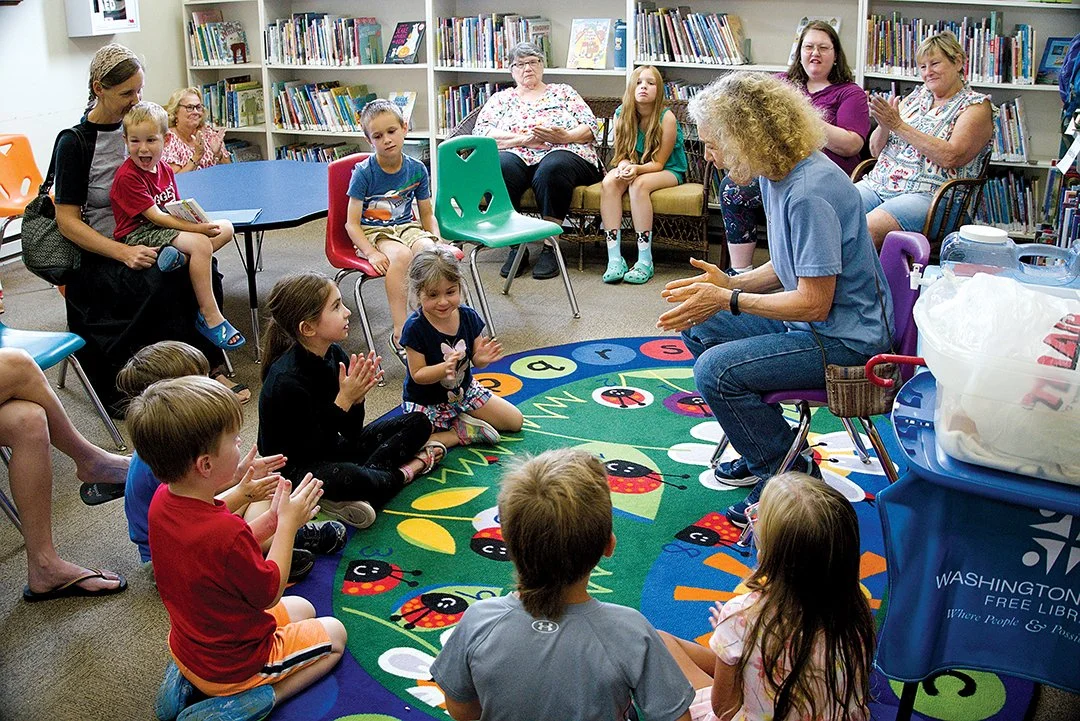
The process can prove to be powerful within an in-person group setting. “Hearing a story in community can affect your openness to receiving it,” says O’Connor. “Even with a community, an audience, of strangers. At our National Storytelling Festival, we often hear audience members talk about the community that is built with both other audience members and the storyteller.”
The National Storytelling Festival, which is sponsored by the International Storytelling Center and held in Jonesborough, Tennessee, is in its 53rd year.
Hannah Harvey, a featured storyteller at the National Storytelling Festival and the International Storytelling Center’s Teller-in-Resident program, refers to the in-person experience of oral storytelling as “story to story, breath to breath.”
“Being present with one another in our voices, in our bodies, in our facial expressions and sharing breath with one another in the same place is central to community building,” says Harvey, who leads storytelling workshops and conducts academic research on performance ethnography—uniting theatre with anthropology.
“And that will always be a part of us no matter what other technologies run alongside orality in our everyday lives. Because we started as oral cultures, sharing stories verbally. They lived on the air.”
Storytelling is part of the human experience and continues to shape who we are as human beings, says O’Connor.
“Stories are a way that people have always used to try and make sense of the world and their place in it,” says O’Connor. “Whether it is through hearing folktales that share community values and pass down lessons from generation to generation, or personal stories which resonate with one’s own experience. Our stories tell us who we are and help us connect to each other.”
Adds Harvey, “When you know your story, you know yourself. Part of our identity as human beings is bound up in our story.”
And for Crawford, “It is all right here,” she says patting her chest over her heart.