No Perfect Pumpkins
By Laura Forrest Hopfauf
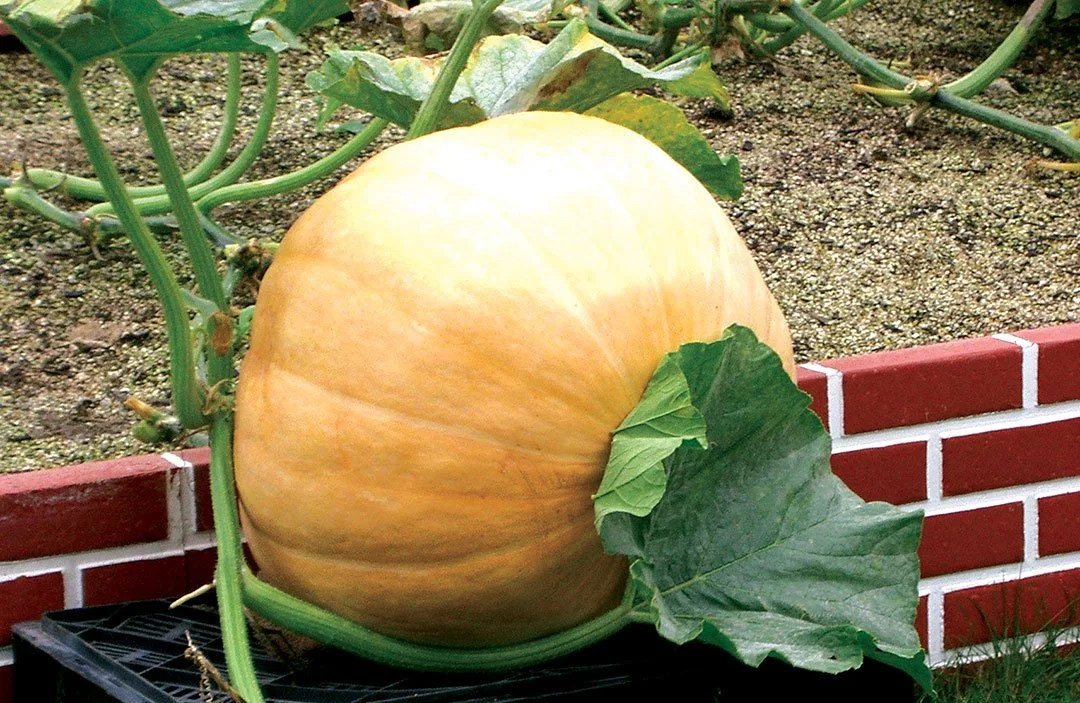
I’ve been searching for the perfect pumpkin for nearly my whole life. Surely, since I could walk and talk. I started young because my father felt the need to grow giant pumpkins in our front yard—the kind of pumpkins that win county fair contests, starting from Atlantic Giant pumpkin seeds and growing to between 200 and 1,500 pounds. I don’t know why he thought this was necessary. We certainly weren’t farmers.
But if I had to guess, I’d say it’s probably a 50-50 divide between it seemed like fun and he wanted to know just how big a pumpkin could end up being. I was around 3 years old when this started. He didn’t keep it up for long; maybe a couple of years. But having a front yard littered with pumpkins bigger than me growing on vines that Dad sporadically injected with a syringe of milk to make them grow larger left quite the lasting impression.
Giant pumpkins aren’t like regular pumpkins. They aren’t round and cute like a jack-o’-lantern. Unable to hold their shape against their weight, they mostly look like a giant orange blob. You can tell it’s a pumpkin, but it looks like a pumpkin that’s been having too good of a time at a Halloween party — everything’s just a bit sideways. Still, as a child, watching giant pumpkins take over our yard was like watching real-life magic. There was a small seed, then there was a baseball-sized pumpkin, then a watermelon, then suddenly there was this massive orange thing that looked like it could hold me inside of it — a real-life after-midnight Cinderella carriage. It wasn’t something I saw anywhere else or in anyone else’s front yard. Those pumpkins were a sign of my own childhood — special and pure and fun.
When Dad stopped growing them (probably because it’s an enormous pain to find a way to get rid of a few couple-hundred-pound pumpkins), my family started going to pumpkin patches all around the county. No pumpkin was ever good enough. We had to walk the whole patch before we could pick one to take home with us. It needed to have a good face to carve; it needed to stand up straight and proud; it needed to be the right shade of orange. There were a lot of requirements to be the pumpkin for our family.
Eventually, picking pumpkins phased out of my life, but things have a way of coming back around. When my husband and I were dating, he took me to a pumpkin patch. He wanted to pick one of the first ones we saw. I promptly said no to that and led him miles through all the fields so we could take a good look at each and every one. He didn’t say anything about it, probably because we were still just dating and this seemed like a minor requirement for a potential marriage.
The next time we went to a pumpkin patch and got dropped off the hayride out into a field full of vines, he immediately pointed to the furthest corner and started heading up the hill so we could look at that pumpkin way over there. Over the past decade, we’ve spent hours in the fall scouring patches for the perfect pumpkin, debating the merits of one over the other like there was actually a judge running a competitive pumpkin-picking contest at the checkout.
There is no perfect pumpkin. I know that. My dad knew that. My husband knows that, too. But it doesn’t make it any less fun. A pumpkin is many things to me: It’s the pride my father had standing over a giant one; it’s love watching my husband carrying the one we deemed ours through the field on his shoulder; it’s joy ogling with my kids over bumpy-skinned or weird-shaped pumpkins. Ultimately, to me, a pumpkin symbolizes finding something special in something ordinary, which is a pretty impressive feat for an over-glorified squash — perfect or not.