Overcoming Obstacles
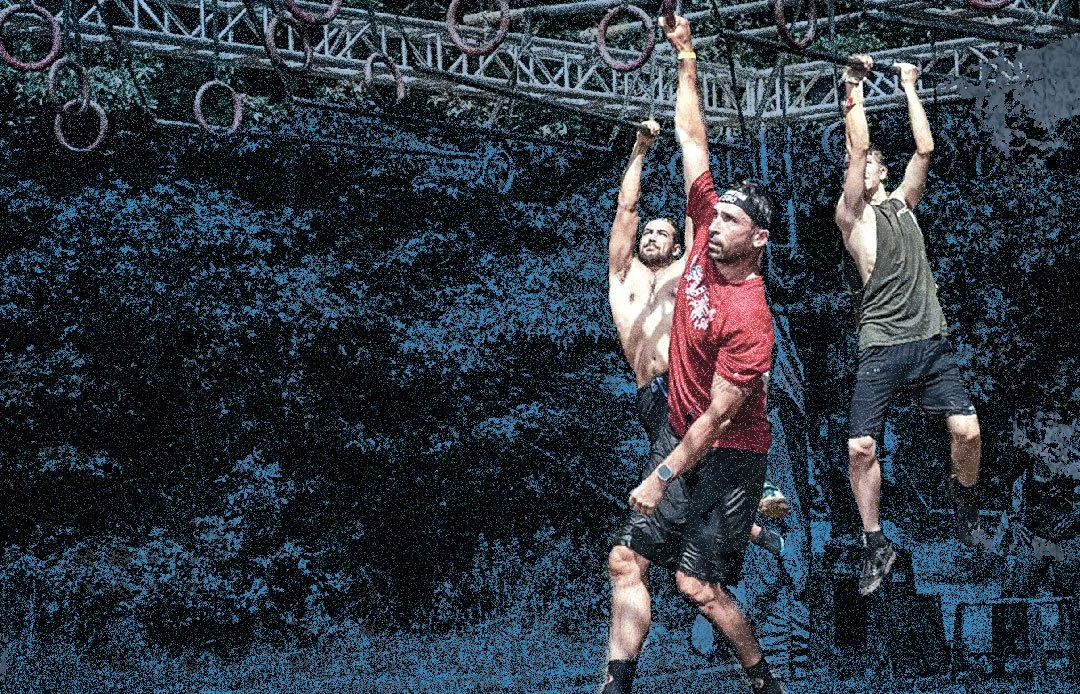
Thomas Burge works his way across the monkey bars part of the Spartan Race obstacle course.
Spartan races improve health and forge friendships that go beyond the gym
By Jennifer Mellace
What happens when people come together to focus on their health, and it turns into something much bigger? Fun is had, lifelong friendships are forged and obstacles are overcome—in this case, literal ones, like barbed wire crawls, spear throws and rope wall climbs.
That’s what happened when Thomas Burge, performance trainer and co-founder of Elite Performance Institute (EPI) in Hagerstown, suggested that some of his early bird workout clients sign up for a Spartan race with him.
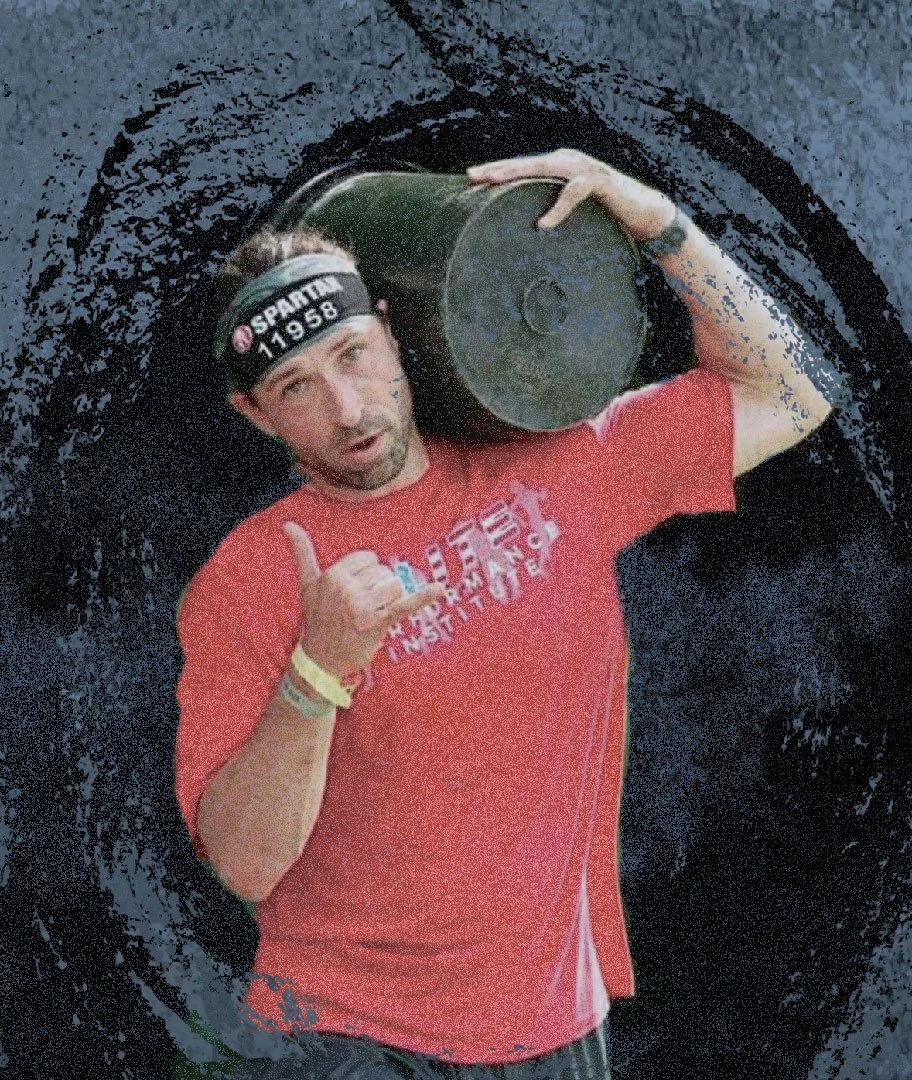
Thomas Burge carries a weighted bucket.
A Spartan race is an obstacle race where competitors run through dirt, mud and water while climbing over walls, carrying heavy objects and completing physical challenges like climbing ropes or traversing monkey bars. Held around the world, there are several distances to choose from, and as the distances increase, so do the obstacles. The Sprint 5k has 20 obstacles, the Super 10k has 25 obstacles and the beast half marathon has 30. The longest race is called the Ultra, a 50k trek that has 60 obstacles. If you do the Sprint, Super and Beast in a year’s time, it’s considered a trifecta.
These challenges test a competitor’s physical fitness, but they also test grit and determination; all while building friendships.
Where It All Began
With more than 20 Spartans under his belt—including five trifectas—Burge’s first was a Spartan Sprint in 2015. Held in the Poconos at the Blue Mountain Ski Area in Palmerton, Pennsylvania, Burge remembers it being very challenging but a lot of fun. “It’s at a ski resort, so it’s about a 1,600-foot elevation climb and then you head back down.”
Joined by three others, it turned out to be an entertaining way to challenge themselves. “We’re competitive within ourselves to see what we can do, and it’s easier when you’re doing it together. Misery loves company.”
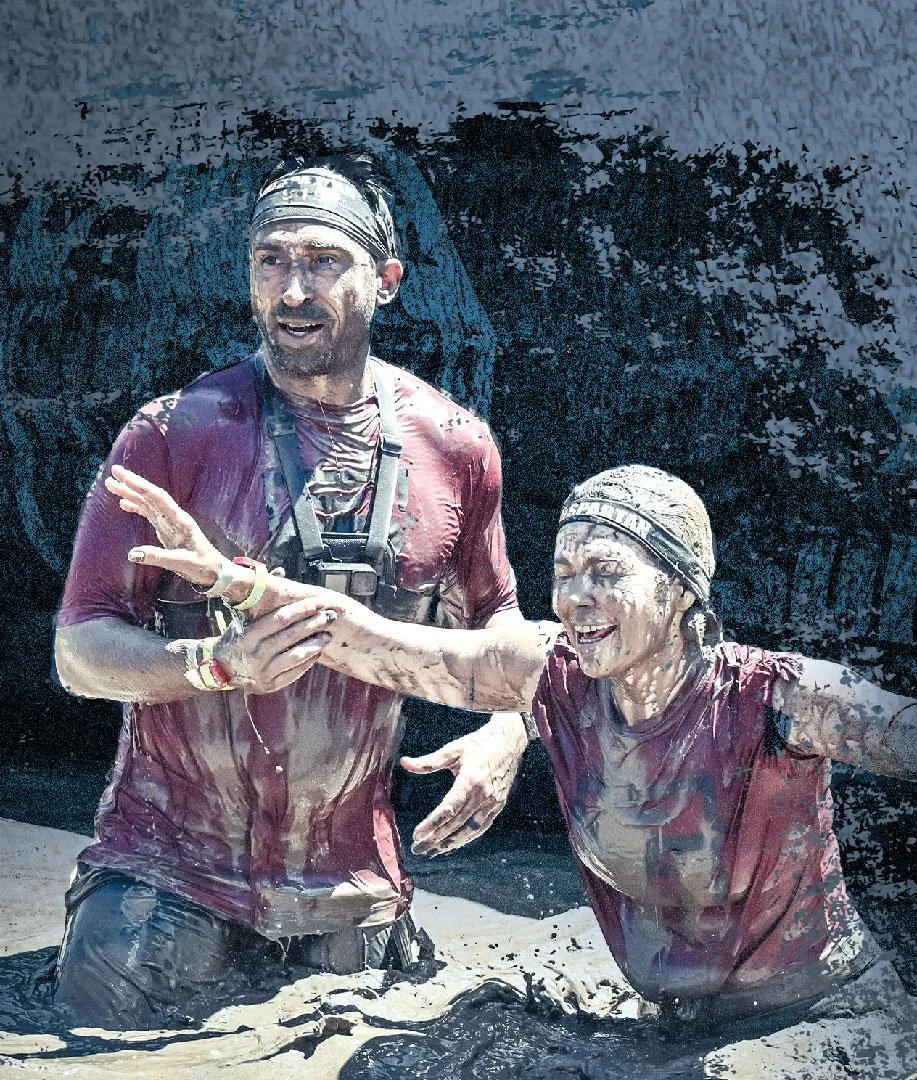
Thomas Burge and Mary Beth Herrera.
During Covid, EPI started an early morning conditioning and strength class called the Early Birds. They would meet at 6 a.m., three days a week. Overtime, more people joined, including many who now participate in Spartan races together. Today, the group meets six days a week.
“After about six months or so, some of the guys started losing weight, getting stronger and moving around a lot better,” says Burge. “That’s when I asked if they wanted to test out what they’ve accomplished, and they said, ‘sure.’ That’s what sparked it.”
One of the first to take up Burge on the challenge was Dan Bedregal of Hagerstown. Having set out on his own fitness journey, he started working out in January 2020, joined the EPI Early Birds toward the end of 2021 and has since lost more than 70 pounds. Now 48, he often keeps Sir Isaac Newton’s First Law of Motion—an object at rest stays at rest and an object in motion stays in motion—at the forefront of his mind.
“I’m at the gym six days a week, as long as I’m not traveling. But I still do workouts when I’m out of town; I stay in motion. But it really helps to have people who push you,” he says about the group. “You get to know everyone and care about the people who might not show up. The program has built friendships.”
The first race as a group was in 2022—a 5k in Woodstock, New York. “We tried it out, it was a good time and we got the bug,” says Bedregal. “We did the 10k next, but I didn’t really want to do the Beast. But Thomas said we need to aim for a trifecta.”
Thinking he’d call Burge’s bluff, Bedregal said the only way he’d sign up for a Beast is if they went to Seattle, Washington, to do it. “I didn’t think anyone would take me up on it—but they said yes. Next thing I knew, we were getting on a plane.”
Bedregal finished his first trifecta that year (2023) and has since completed 11 Spartan races and three trifectas with a fourth trifecta planned for this year, which includes races in Vermont, Arizona and Tennessee.
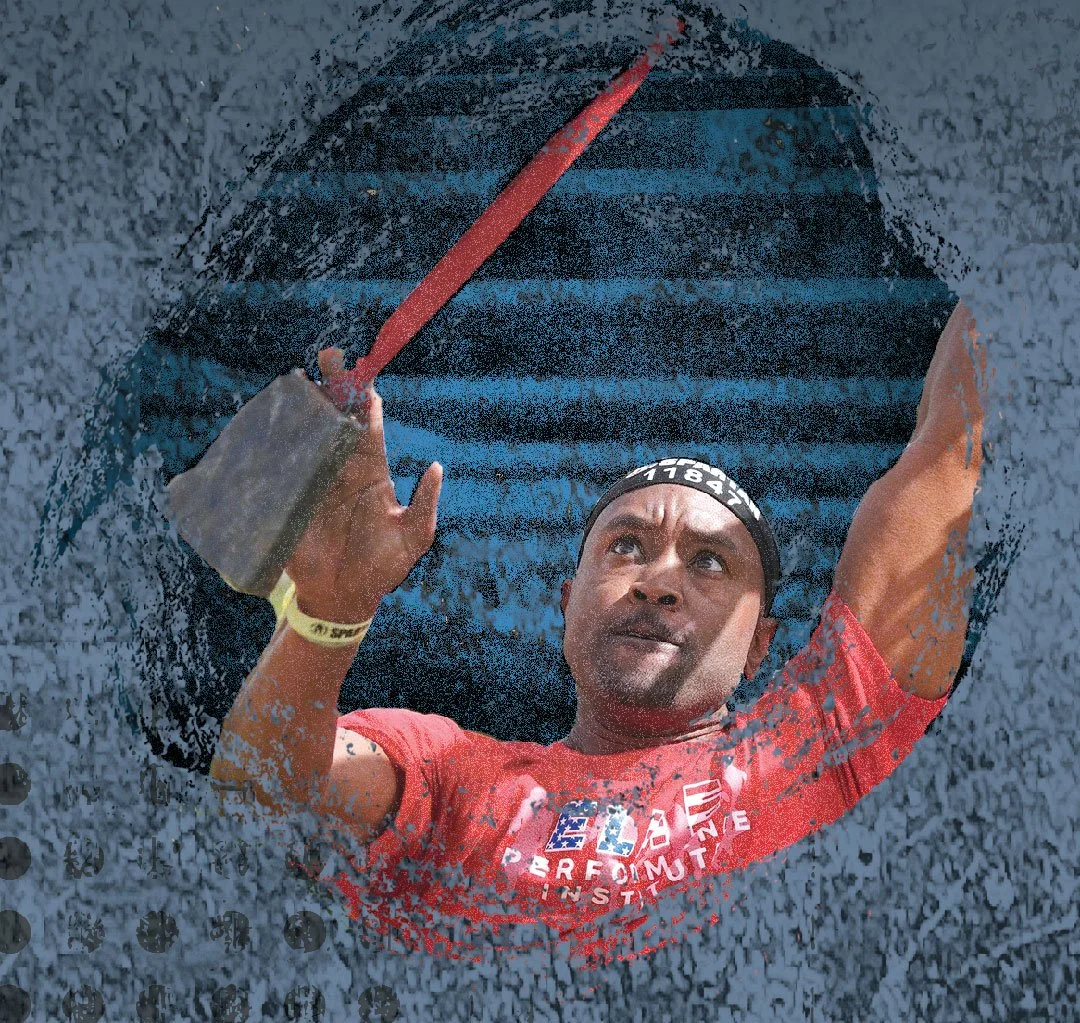
Garry Pate crosses monkey bars at a Spartan Race.
A Team Effort
While they don’t have an official name, they go by Team EPI, which consists of 28 people—six of whom race consistently. They’ve completed races in more than eight states, including North Carolina, Colorado, New York, Massachusetts, Virginia and Montana. The group plans to add Vermont—one of the hardest races—to the list this September.
Garry Pate, 55, has been a client since 2020 and is also one of the first members of Team EPI. Having exercised all his life, he joined Burge and the Early Birds because he liked that it was an older group of athletes, wasn’t an overly crowded gym and wasn’t far from his home in Hagerstown.
“I like the fact that there is a group of similarly aged adults who get together to sweat, without drama,” he says. “It’s such a great group of people.”
Pate was also part of the first Beast race in Seattle. “I was apprehensive, but we went out early and relaxed before the race,” he remembers. “The course was flat but beautiful, along a river and the weather was perfect. It was a great day and we all finished.”
With so many races under their belt, the group is looking forward to challenging themselves even more. That’s where the Killington, Vermont, race enters the picture. The race is known as “Joe’s backyard” because Joe De Sena, the founder and CEO of Spartan Race, was born near the Killington Ski Resort. Complete with “brutal climbs, punishing descents and relentless terrain,” this course is marketed as the most challenging and rewarding race in the Spartan series. While Burge has tackled it before, he’s excited to share the grueling experience with the others.
“Vermont was the only [Spartan] that I’ve ever thought, I could really walk off of this one right now,” says Burge. “It took me six hours and 23 minutes to complete. Normally, the group finishes a Beast anywhere between four to six hours. But Vermont has 7,000 feet of elevation change. I cramped so badly that it took me even longer to get through.”
The difference this time is that Burge will have his clients—now also friends—joining him. And while the group as a whole may split into two groups—a faster pace and a slower pace—no one is ever left behind.
“We’re only as fast as our slowest team member,” says Pate. “We workout as a group and run as a group.”
Overall, the Spartan races foster that teamwork among athletes.
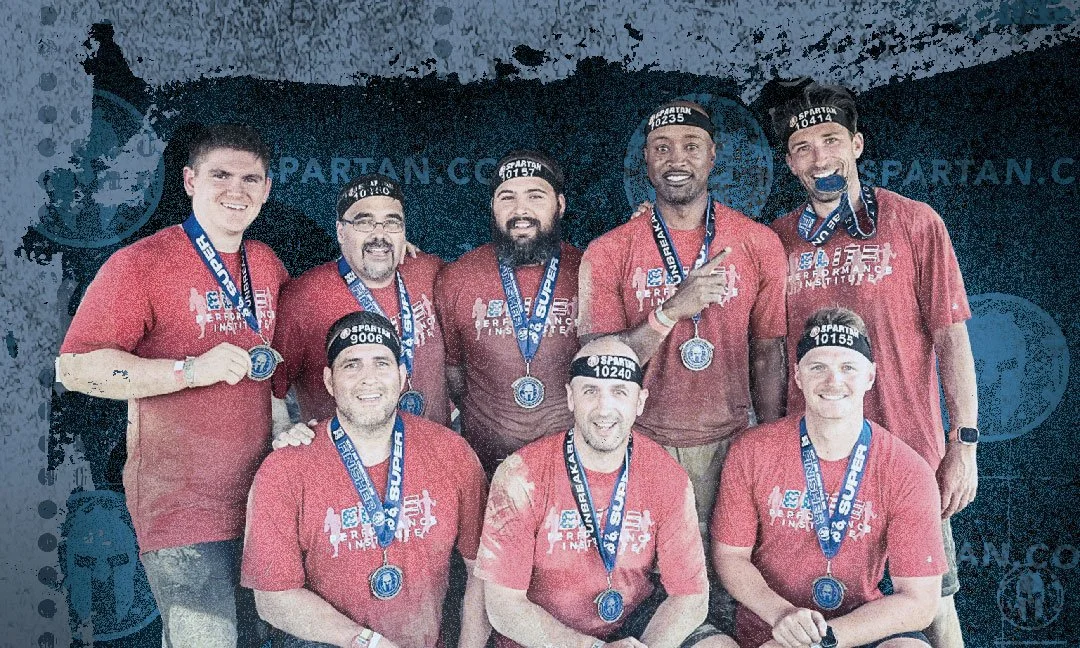
Back row (left to right): Mason Young, Rich Vieira, Zayne Bedregal, Garry Pate, Thomas Burge; front row: Dan Bedregal, Chris Plumadore, Luke Harsh
“I’ve helped strangers multiple times,” says Burge. “I remember one race where I helped a girl who was struggling with the sandbag carry at the end of the course. We both picked up our sandbags at the same time. Mind you, the mud was up to my shins. She was walking in the mud, got stuck and face planted with the sandbag on the back of her head. I helped her up and she wanted to try again. She put it back on her shoulders, walked maybe six more steps and the exact same thing happened. I said, ‘Give me your sandbag. You’re walking out of here without it. You can have it back when we’re out of the mud.’”
“You’re not strangers on the course,” he says. “If someone gets stuck at an obstacle, the person behind them will ask to help. I’ve done it multiple times for different people. Everyone’s super friendly. It’s just people trying to do something challenging and have fun with it.”
Friends Beyond the Gym
Through all the hours of training and all the races, this group of athletes has come to realize that the motivation behind the Spartan isn’t just about the race. It’s about the friendships they’ve forged over time.
“Even though they’re clients, I would consider everyone good friends at this point,” says Burge. “We hang out outside of the gym. We go out to dinner, watch basketball games or whatever it might be. We even started a little tradition on the first weekend of March Madness. We all come to the gym and either bring some food or order pizza and sit around and watch basketball all night. One year we actually spent the night here, we haven’t done that again.”
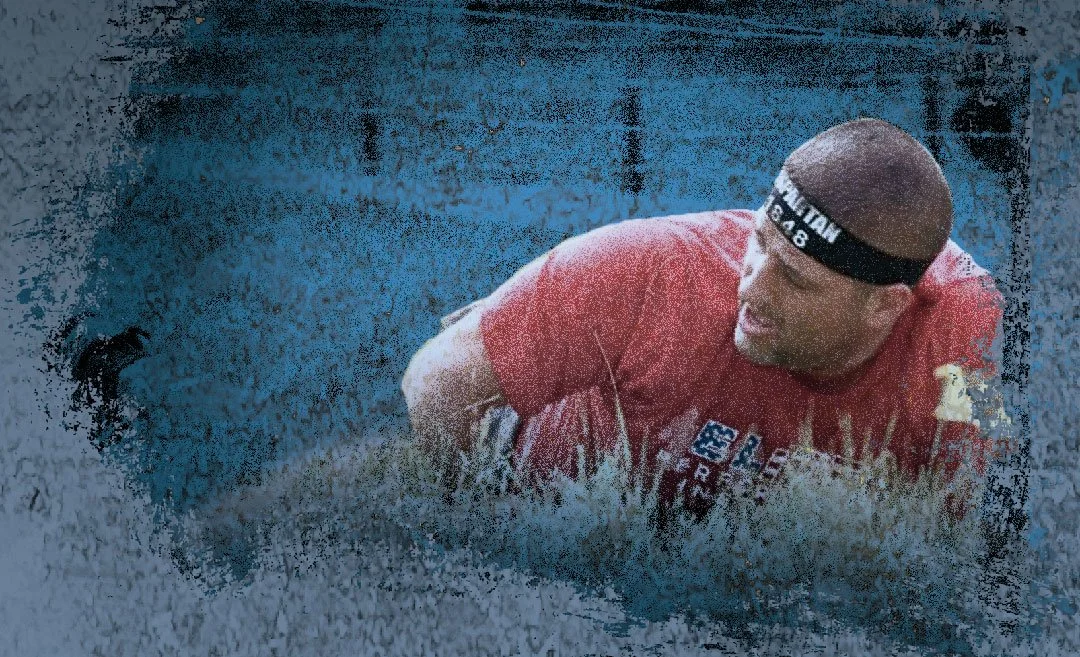
Dan Bedregal works his way under barbed wire during a Spartan race.
The trips they take to the race locations, which often include family members, has played a big part in shaping these friendships. “We’ve grown to know each other and each other’s families,” says Pate. “We go on vacations together and to our kids’ birthday parties and weddings. Everyone is rooting for each other.”
One of the most memorable Spartan trips for the athletes was to Colorado. “That was our largest group,” says Burge. “There were 17 people who raced and more than 20 of us who went, including spouses, kids, cousins. We rented a big house together and collectively paid for a chef to come in and cook us dinner one night. That was fun. It’s more about shared company and enjoying it with everyone.”
The other two races in this year’s trifecta line-up are Nashville and Arizona, partially because the group wants to vacation together in these places. “It’s turned into this big family trip where everybody gets along,” says Burge.
What’s Next?
So, what does the future hold for this group? While Spartans might come to an end, unless there’s a location/vacation the group wants to do—Burge has his sights set on Honolulu, Hawaii, Team EPI doesn’t plan on sitting idle.
“I don’t think we will repeat any of the ones that we’ve done,” says Burge. “There might be three more next year, and then maybe we’ll turn to something else, like Go Ruck, HYROX, or DEKA FIT competitions. Just finding something else to push ourselves and to keep staying fit to do these adventures.”
Pate agrees. “I’d like to continue trifectas as long as we can. I have no current goal for an Ultra, but there are other competitions outside of Spartan races that we can do as a group. I just keep the quote from “The Shawshank Redemption” in mind, ‘It comes down to a simple choice, really: get busy living or get busy dying.’ I want to be strong for the years ahead.”
Continuing to challenge each other is part of the drive. “Everyone really sees and holds each other to a high standard,” says Burge. “We joke with each other, pick at each other, but it’s all from the bottom of our hearts, because we want to see everyone do well.”
In the end, this group of athletes and friends will continue to come together around the same realities—bodies that may not recover like they used to, marriages, kids and careers already in motion; and sharing the vulnerability that comes with trying something hard and new when many others their age may be slowing down.
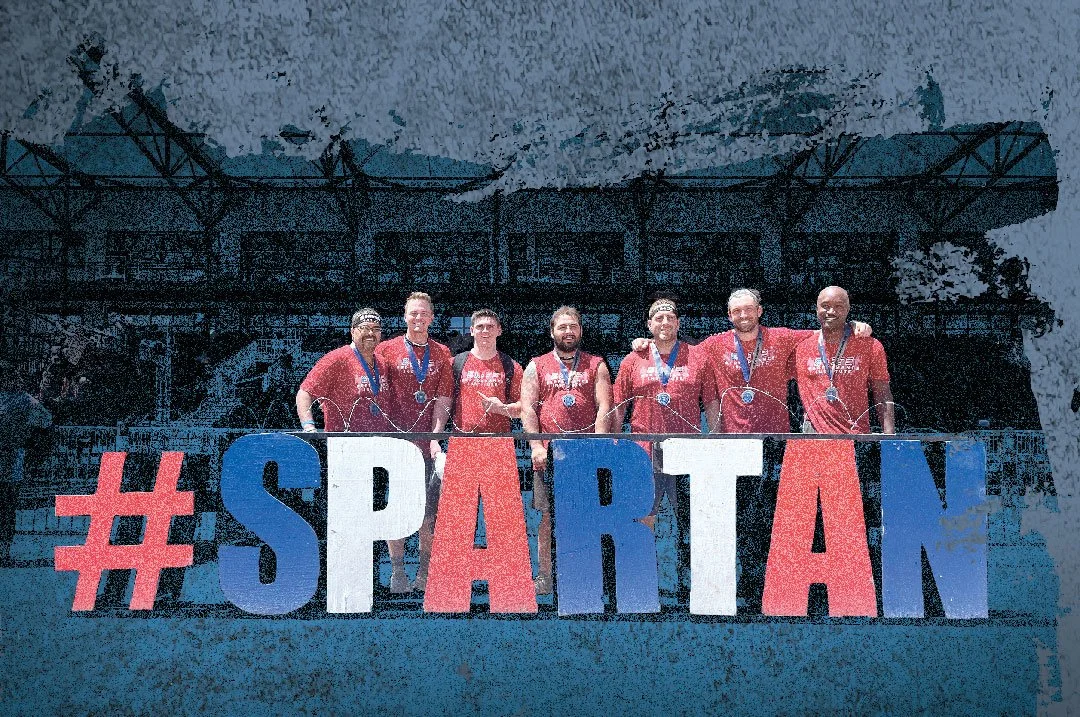
EPI team members (left to right) Rich Vieira, Luke Harsh, Mason Young, Zayne Bedregal, Dan Bedregal, Thomas Burge, Garry Pate.